
STEM for Kids: Little Minds, Big Ideas
The Importance of STEM for Young Minds
“Because learning should be hands-on, not hands-off!"
In today's rapidly evolving world, STEM education—encompassing Science, Technology, Engineering, and Mathematics—has emerged as a cornerstone in preparing young minds for future challenges. Early engagement in STEM activities is not merely beneficial; it is crucial for cultivating skills that underpin critical thinking, creativity, and problem-solving abilities. These skills are incredibly relevant as children navigate their educational paths and real-life situations.
Participating in STEM programs encourages children to ask questions, explore, and conduct experiments. This hands-on approach nurtures a sense of curiosity and promotes an innovative mindset. Children learn to analyze information, identify problems, and devise solutions, all pivotal traits for academic prowess and everyday living. For example, when a child participates in a science experiment, they are not just following instructions; they are hypothesizing, experimenting, and learning from trial and error, which solidifies their understanding of the scientific method.
Additionally, the integration of technology in STEM education fosters digital literacy—an essential skill in our technology-driven society. By engaging with various tools and platforms, children develop competency in navigating the digital landscape, enabling them to adapt in an increasingly digital world. This experience can spark interest in further studies and pursuance of careers in STEM fields, which are projected to be among the fastest-growing job sectors globally.
Ultimately, the importance of STEM for young minds extends beyond immediate academic achievements; it lays the groundwork for lifelong learning and adaptability. As children immerse themselves in STEM activities, they not only build foundational knowledge but also acquire indispensable skills that will serve them well throughout their lives, shaping them into innovative thinkers and problem solvers in an increasingly complex world.
Hands-On STEM Activities and DIY Science Experiments
Engaging children with hands-on STEM activities is essential for cultivating their interest in science, technology, engineering, and mathematics. These interactive experiences not only entertain but also educate, fostering curiosity and problem-solving skills. Below are some exciting, easy-to-do DIY science experiments and projects that can be readily performed at home.
One classic experiment is the volcano eruption, which can be created using simple household items such as baking soda, vinegar, and food coloring. The reaction between these substances results in an explosive eruption that vividly demonstrates a chemical reaction. This activity encourages children to ask questions about chemical reactions and the role of gases in that process.
Another excellent project is building simple circuits to introduce concepts of electricity and how circuits work. Using a battery, some copper wire, and a small light bulb, kids can create a basic circuit and observe how electric current flows. This hands-on experience will help them understand the essential principles of electrical engineering.
A third engaging activity is creating a homemade compass. By magnetizing a sewing needle and floating it on a small piece of cork in water, children can learn about magnetism and the Earth's magnetic field. This experiment not only teaches them about direction but also encourages exploration of Earth sciences.
These activities, among others, fulfill the dual purpose of being both educational and fun. Engaging in such hands-on projects will spark children's curiosity, enhance their understanding of scientific concepts, and enable them to learn through play. Each experiment offers an opportunity to explore the world of STEM in an enjoyable and interactive manner, laying a solid foundation for future learning.
STEM Kits and DIY Projects Available for Kids
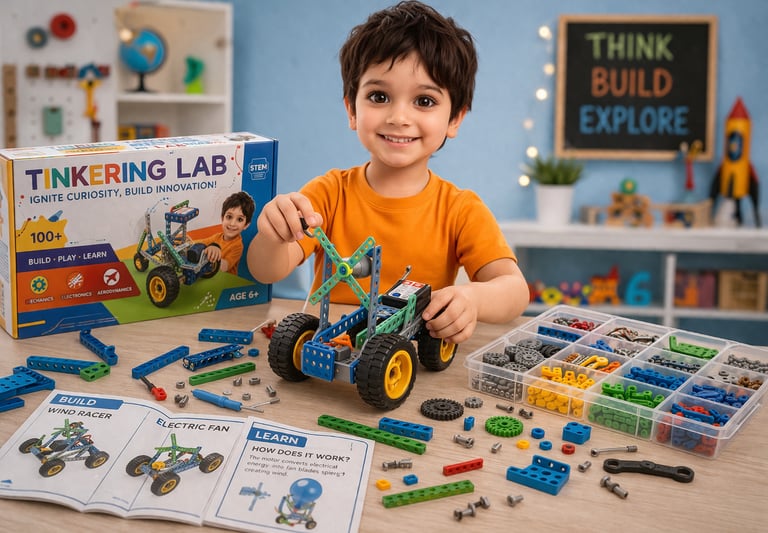
The realm of STEM (Science, Technology, Engineering, and Mathematics) education extends beyond traditional classrooms, blossoming into various kits and DIY project options available for children. These resources are designed to engage young minds in hands-on activities that spark curiosity and foster critical thinking skills. Notably, STEM kits are often tailored to different age groups, ensuring that children can learn at their own pace while enjoying the process of discovery.
One popular brand, LEGO Education, provides a series of STEM kits that focus on building and coding. The LEGO Boost Creative Toolbox, for instance, helps children aged 7 and above explore robotics through a fun and interactive platform, combining the joys of building with the fundamentals of computer programming. Another well-regarded option is the Snap Circuits set, which introduces kids to electrical engineering by allowing them to create functioning circuits safely and easily.
For younger children (ages 4-8), the Osmo Genius Starter Kit stands out as an excellent educational tool. This kit integrates physical play with digital learning, utilizing an iPad to enable hands-on learning in subjects such as math, spelling, and creativity. Additionally, the Discovery Kids Science Lab Kit provides an exciting way for children to conduct experiments at home, encouraging a practical understanding of scientific principles.
Furthermore, companies like KiwiCo offer subscription boxes filled with DIY projects tailored to various age ranges, ensuring that STEM learning remains constant and diverse. Each month, children receive a new project that challenges their intellect while promoting creativity.
By providing access to reputable STEM kits and DIY projects, parents can encourage their children to explore the world of science and engineering in an enjoyable and engaging manner. These resources play a significant role in preparing the next generation of thinkers, innovators, and problem solvers.
Incorporating STEM into Daily Life
Integrating STEM (Science, Technology, Engineering, and Mathematics) learning into daily life can be a seamless and engaging experience for children. By leveraging everyday activities, parents and caregivers can create rich learning opportunities that spark curiosity and foster problem-solving skills. One effective method involves using common household items to initiate scientific inquiry. For example, kitchen experiments can demonstrate principles of chemistry; mixing baking soda and vinegar illustrates a chemical reaction while cleaning surfaces.
Exploration is crucial for fostering a scientific mindset. During routine tasks, caregivers can encourage children to ask questions about their surroundings. For instance, while cooking, parents might ask their children how they would measure ingredients accurately, prompting them to think about measurement units and their practical application. Furthermore, when engaging in outdoor activities, families can explore nature by observing local wildlife, discussing ecosystems, or identifying plant species. This not only strengthens observational skills but also allows for real-world applications of scientific concepts.
In addition to hands-on activities, utilizing technology can further enhance a child’s understanding and interest in STEM. There are numerous educational videos and apps designed specifically for children, which can introduce STEM topics in an engaging and interactive way. For example, coding apps allow children to learn programming fundamentals through games, while math-based games can improve numerical skills in an entertaining format. Online platforms like Khan Academy offer a variety of resources tailored for young learners, covering diverse subjects within the STEM spectrum.
By incorporating these strategies into everyday life, caregivers can significantly enrich their child’s educational journey, reinforcing the importance of STEM beyond the classroom. This approach not only cultivates a love for learning but also prepares children for future challenges in a technology-driven world.

Contacts
Socials
Subscribe to our newsletter
support@otgscience.in
Copyright © 2025 otgscience.in
.