
FIFA World Cup 2026 and The Football-Shaped Molecule
The Scientific Transformation of Football
"Scientists measure pressure in pascals. Football fans measure it in penalty shootouts."
Football, often revered as the beautiful game, extends far beyond its status as merely a sport. It has evolved into a complex interplay of various scientific disciplines that collectively contribute to its enhancement and global impact. At the core of this transformation is the application of physics, which plays a crucial role in understanding the motion of the ball, the biomechanics of player movements, and the engineering of equipment such as high-performance footwear and apparel.
In addition to physics, biology significantly influences player performance through the study of human physiology and biomechanics. Advances in sports medicine have led to improved injury prevention and rehabilitation techniques, ensuring that athletes can perform at their peak while minimizing risks. Monitoring health parameters such as heart rate and oxygen levels through biometric sensors serves as a bridge between biology and technology, allowing for tailored training regimens.
Chemistry also enters the arena, particularly in the development of sports nutrition. The formulation of energy gels, recovery drinks, and supplements backs athletes' performance and recovery, optimizing energy utilization during intense matches. Coupled with psychology, it aids players in maintaining focus and mental resilience to excel under pressure.
Artificial intelligence (AI) and data science have begun to revolutionize coaching and analytics. By analyzing vast amounts of data, teams can evaluate player performances, make informed tactical decisions, and enhance training programs. This data-driven approach not only optimizes individual player contributions but also helps teams enhance their overall strategies and adapt to opponents.
As the football community looks towards upcoming events, such as the 2026 FIFA World Cup, the integration of these scientific disciplines will be more critical than ever in evolving the sport. The synthesis of innovation and established knowledge will continue to pave the way for unprecedented advancements in player performance, fan engagement, and the overall experience of the game.
The Role of Fullerene and Geometry in Football Design
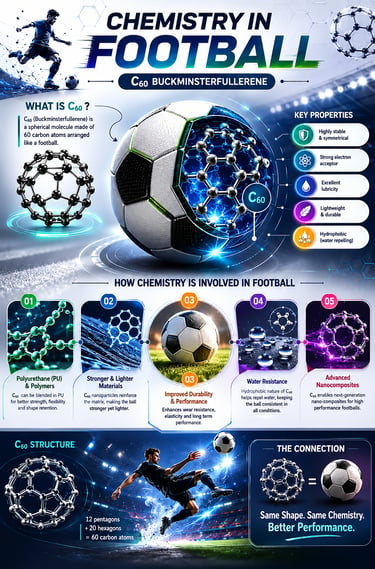
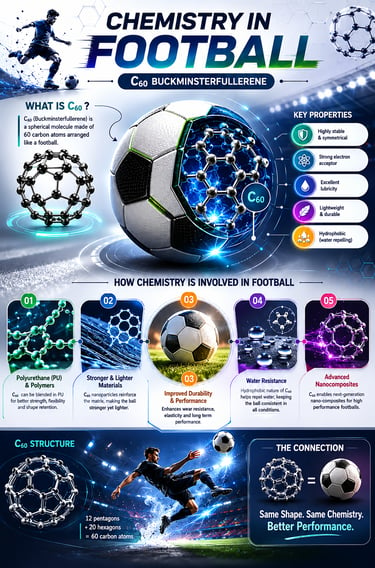
The design of a football intricately combines science and artistry, wherein geometry and molecular structures such as fullerene play a vital role. Specifically, buckminsterfullerene, commonly known as "buckyballs," is a spherical structure made up of 60 carbon atoms arranged in a configuration resembling that of a soccer ball. This unique formation is essential in optimizing the physical properties of a football. The fullerene structure contributes to the sphere's durability and resilience, ensuring that the ball maintains its shape and integrity throughout the rigors of play.
The geometric aspect of a football cannot be understated. A traditional soccer ball often adopts a hexagonal and pentagonal panel design, which is not only aesthetically pleasing but also functional. This geometric arrangement allows for a more uniform surface, aiding in aerodynamics and improving the ball’s trajectory during flight. Such a design minimizes the drag and enhances the predictable movement of the ball, essential for players who rely on precision and control.
Through sophisticated engineering, the interplay between the fullerene structure and geometric design enhances the performance characteristics of the ball. The symmetrical distribution of the panels coupled with the high strength-to-weight ratio found in fullerene materials allows for a greater control during gameplay. As a result, modern football designs benefit from these scientific principles, providing players with superior tools to express their skills on the field.
This fusion of art and science in football design speaks volumes about the evolution of the sport, marking a transition toward innovative approaches that combine traditional craftsmanship with advanced materials science. Such advancements not only elevate the game but also reflect the ongoing collaboration between disciplines, showcasing how modern technology influences the physical attribute of football.
The Chemistry of Carbon and its Variants
Diamond, with its crystalline structure, is renowned for its unparalleled hardness and optical properties. This characteristic makes it invaluable in the manufacturing of protective gear and equipment that require wear resistance. The hardness of diamond contributes to creating durable surfaces on footballs and protective wear, ensuring longevity and reliable performance on the field.
On the other hand, graphite's layered structure allows for exceptional lubrication properties and electrical conductivity. This makes it suited for applications such as friction materials in mechanical components, ensuring smoother performance of training and playing equipment. Moreover, its use in the design of modern footballs enhances the ball's resilience and ability to withstand various playing conditions.
Graphene, a single layer of carbon atoms arranged in a two-dimensional lattice, has attracted significant attention for its astounding strength and lightweight properties. Its potential applications in sports gear can revolutionize the performance of equipment, contributing to advancements in lightweight boots, which provide players with enhanced agility and comfort.
Lastly, fullerene, a spherical form of carbon, has begun to see applications in nanotechnology and material sciences. Its unique properties can lead to the development of innovative materials that could usher in a new era of smart football equipment equipped with sensors and technology to gather performance data, thus providing real-time feedback on players’ performance.
Looking Ahead: Science and Football at the 2026 FIFA World Cup
The upcoming 2026 FIFA World Cup is poised to be a landmark event, showcasing not only thrilling matches but also the remarkable integration of science and technology into the realm of football. As the sport evolves, advancements in various scientific fields are expected to significantly enhance player performance, health management, and tactical strategies on the pitch. This fusion of the sporting world with scientific innovation is anticipated to create a more dynamic and engaging experience for fans and participants alike.
Player health and performance, once simply a function of physical training and skill, have been increasingly influenced by modern scientific research. For instance, the implementation of wearable technology will provide coaches with real-time data on player biometrics, enabling tailored training regimens that optimize fitness while mitigating the risk of injuries. This data-driven approach allows teams to make strategic decisions that enhance their competitive edge, as players will perform at their peak physical condition throughout the tournament.
Additionally, advancements in sports science could transform game strategies. The use of artificial intelligence and analytics may lead coaches to analyze vast amounts of data to gain insights into the opponent's tendencies and strengths. This evidence-based decision-making is shaping how teams prepare for matches, adjusting their strategies dynamically based on scientific findings. For example, video analysis combined with performance metrics can refine player roles on the field, enhancing teamwork and coordination among team members.
The excitement surrounding the 2026 FIFA World Cup is thus not only about the games themselves but also about the innovative approaches that will actively shape the future of football. As we look forward to this global event, the application of science and technology promises to redefine our understanding of the beautiful game, elevating it to new heights and captivating audiences worldwide.




Contacts
Socials
Subscribe to our newsletter
support@otgscience.in
Copyright © 2025 otgscience.in
.